The house is heated by an oil boiler and radiators. Each radiator has a tado X smart valve, twelve in all, and a tado Smart Thermostat X is wired to the boiler. In tado’s own setup, all of that is tied together by the tado app and its cloud, through a small bridge. I wanted none of it: no tado account at run time, no bridge, and nothing that stops heating the house because a server somewhere is down.
Today the valves and the thermostat talk Matter over Thread, Home Assistant decides when the boiler fires, the bridge is off, and tado’s servers are blocked. Here’s how it got there.
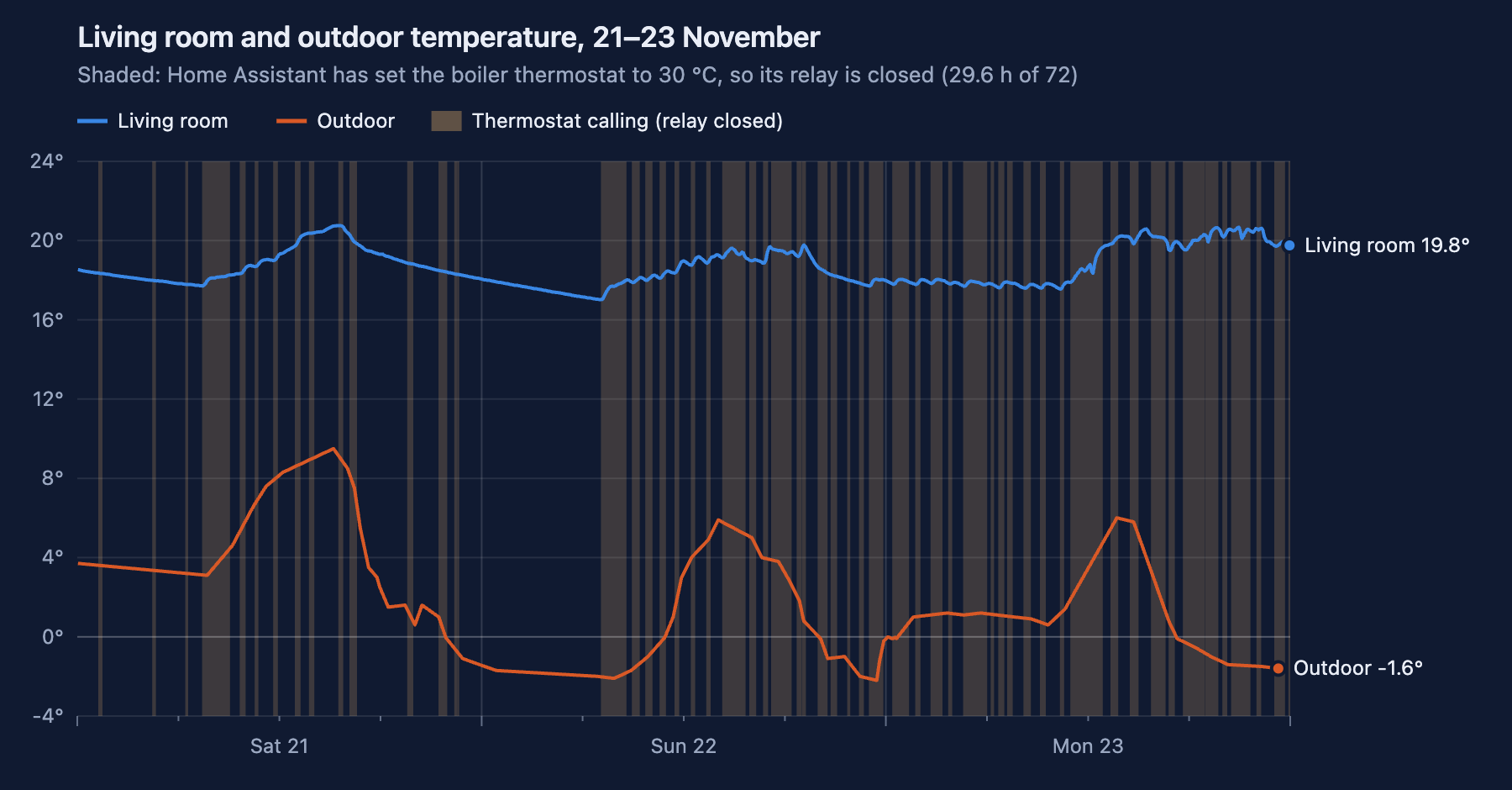
Real data from Home Assistant, Saturday 21 to Monday 23 November. The shaded bands are the times the thermostat was calling for heat: Home Assistant had set it to 30 °C, which closes the relay to the boiler. That’s 29.6 hours out of 72, in 56 calls. In the long unshaded stretches no valve in heat mode was below its target; on the Saturday most valves were in off mode, which the rule ignores.
The valves on Matter
tado X devices speak Matter over Thread, so they can join any Matter controller without the tado app. I have three controllers, and I add every device in the same order: UniFi first, then Home Assistant, then Apple Home.
That’s harder than it sounds with tado X, because each device accepts only five controllers, called fabrics. Apple Home takes two of them, UniFi one, Home Assistant one. That leaves one spare, and failed pairing attempts eat into it. When I checked, every tado device had a ghost “Home Assistant” fabric left over from an earlier attempt, and one valve had all five slots taken by fabrics nobody could name. That one needed a factory reset.
What helped:
- Read the fabric list first. Home Assistant’s Matter diagnostics show every controller on a device. An admin can remove a ghost fabric before adding a new controller.
- The Mac’s Home app can make pairing codes. In the accessory settings, “Connected Services” lists the other ecosystems and can remove them, and “Turn On Pairing Mode” shows a code after about half a minute. The iPhone doesn’t show one in the same situation.
- New devices start on the iPhone. UniFi commissions only devices already on the network, not over Bluetooth, so a fresh valve gets scanned into Apple Home first. Then I open a pairing window and add it to UniFi and Home Assistant from there.
One valve had been “No Response” in Apple Home for over a year. After a reset and the iPhone route it came back with the others. All twelve valves and the thermostat are now on Matter, each with four of its five fabrics in use.
Home Assistant fires the boiler
Over Matter, a tado X valve reports the room temperature, its target and its mode. It doesn’t report a heating demand or how far it’s open. And the new thermostat lives only in Apple Home and Home Assistant, not in the tado app, so tado’s own valve-to-boiler link isn’t there. Home Assistant makes that link itself:
- Demand. A room asks for heat when its valve is in heat mode and the room is at least 0.3 °C below the target. It keeps asking until the room reaches the target.
- Relay. When any room asks, Home Assistant sets the thermostat to heat at 30 °C, which closes its relay and fires the boiler. When none does, it sets 5 °C and the relay opens.
- Pacing. At least ten minutes between switching on and switching off. The command is sent again every five minutes, at start-up, and whenever someone changes the thermostat from Apple Home.
- Off switch. One toggle stops Home Assistant from touching the thermostat at all.
The demand check is one template sensor. The core of it:
{% set marche = this.state == 'on' %}
{% set ns = namespace(n=0) %}
{% for s in states.climate
     if s.state == 'heat'
     and device_attr(s.entity_id, 'model')
         == 'Smart Radiator Thermostat X' %}
  {% set c = s.attributes.current_temperature %}
  {% set t = s.attributes.temperature %}
  {% if c is number and t is number
        and ((c < t) if marche else (c <= t - 0.3)) %}
    {% set ns.n = ns.n + 1 %}
  {% endif %}
{% endfor %}
{{ ns.n > 0 }}
The sensor goes unavailable if no valve answers at all, so a dead Thread network never reads as “no demand”.
I checked the relay with a meter on the boiler’s call line: 0 V at 5 °C, 230 V at 30 °C. The first 30 °C command did nothing, and switching back to 5 and then to 30 again did. That’s one more reason the command is repeated every five minutes instead of trusting a single write.
There are three alerts: the thermostat not following the demand for 20 minutes, no valve reporting, and Home Assistant itself going silent. That last one doesn’t go through Home Assistant. My monitoring stack sees the boiler data stop arriving and sends a push straight to my phone.
Cutting the cloud, and the evening Thread split
With everything on Matter, the tado bridge only did two things: route Thread traffic, and talk to tado’s cloud. I blocked the tado domain on my DNS server, then blocked the bridge’s own internet access.
About half an hour later, the bridge stopped routing and started rebooting every 15 minutes or so. The Thread network split in two. The tado devices and the front door lock stayed with the bridge, on its own network prefix, and my Apple border routers withdrew the route to that prefix. From 19:55 all fifteen devices on that network were unavailable in Home Assistant, and the “boiler not controlled” alert fired.
Unblocking the bridge and power-cycling it didn’t heal the split. Switching the bridge off did. It was 21:10. Within three and a half minutes, all the valves, the thermostat and the lock rejoined through the three Apple border routers. The bridge has stayed off since, on a smart plug I don’t touch.
The devices still try to reach tado. In the first five minutes after the change, the firewall blocked 161 attempts to tado’s device gateway, all from one HomePod mini, which is a Thread border router and forwards the devices’ traffic to the internet. Those attempts are blocked by IP address, so if tado moves that server, the rule needs updating.
What Thread taught me along the way
- Border routers on another VLAN need IPv6 there. Before all this, the lock’s Thread parent was the tado bridge, which sat on my IoT VLAN. When I turned IPv6 off on that VLAN for an unrelated reason, the lock went unavailable. It was still answering over Thread, but the bridge routes off-mesh replies through its own Wi-Fi, and with no IPv6 there they went nowhere. A static ULA prefix on that VLAN fixed it.
- Thread and Zigbee can sit on the same channel. My Thread network is on channel 25, and so is Zigbee. The lock once reported 19 of 91 transmissions blocked because the channel was busy. I haven’t moved either network yet, since that means re-pairing a lot of Zigbee devices.
- The bridge was doing useful work. It sat next to the front door and gave the lock a good link: −65 dBm and about 15 % frame errors. Without it the lock reaches a router further away at −81 dBm, with 40 to 54 % frame errors. Reading its state still takes about a second, but slow or stalled opens may come back. The fix is a Thread router near the door, and that’s still to do.
What still needs looking after
- The burner isn’t measured. I know when Home Assistant asks for heat, not when the burner actually runs or how much oil it burns. A power meter on the boiler’s circuit is the next step.
- If Home Assistant dies while calling for heat, the thermostat stays at 30 °C and the boiler keeps going. The outside alert is there for exactly that.
- No valve position. With no valve position over Matter, demand is worked out from temperatures. It works, but it can’t tell a valve that’s wide open from one that’s barely cracked.
- A valve in off mode never asks for heat. The rule only looks at valves in heat mode. If a valve is switched off, its room can get as cold as it likes and the boiler won’t know.
- The lock’s weak link, described above.
- The IP-based block on tado’s device gateway.
- Battery warnings. With the cloud blocked, I rely on the battery-low sensors that come over Matter.
What’s public and what’s mine
There’s no code to publish here beyond the template above. The rest is a Home Assistant package with one automation, two helpers and the alerts, all named after my rooms. If you’re doing the same with tado X or another Matter valve, the demand rule and the “repeat the command” lesson are the parts worth copying.
Questions about fabrics, Thread routing or the boiler logic are welcome in the comments.
Comments
Loading comments…